
Under a Bortle 1 Sky: Inside Nevada's First Telescope Farm

 Apple Podcasts

 Spotify

 Castro

 Amazon Music

 iHeartRadio

 RSS Feed
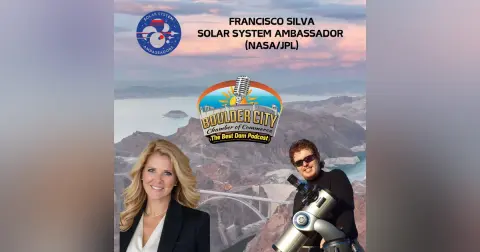
In this episode, Jill Lagan sits down with Francisco Silva, a NASA/JPL Solar System Ambassador, astronomy educator, and operator of Death Valley Observatories, Nevada's first telescope farm in Amargosa Valley.
Francisco has spent over a decade bringing astronomy to Southern Nevada, visiting hundreds of schools and libraries and reaching about 3,000 kids a year. Now he's helping stargazers worldwide use one of the darkest skies left in the continental United States, even if they never leave their couch.
Join Jill and Francisco as they explore why NASA is as much about protecting Earth as leaving it, how a remote desert "telescope farm" works, and what exploring the cosmos can teach us about curiosity, humility, and the human story.
DISCUSSION
- What Is a NASA Solar System Ambassador? Francisco explains how the program grew out of the Galileo Ambassador program in the late '90s. Today more than 1,200 volunteers across the U.S. share NASA and JPL's work with their communities, from Mars helicopters to the Hubble and Roman telescopes.
- NASA's Mission Is Bigger Than You Think: From food security and weather satellites to catastrophe response, Francisco shows how much of NASA's work is aimed at preserving the value of Earth. He also recalls how the Apollo missions went to the moon and ended up helping us discover our own planet.
- Why a Telescope Farm? Light pollution isn't new. Astronomers complained about candlelight in Paris in the 1700s. Francisco explains why the dark stretch between Death Valley and southern Utah is so valuable, and why he's working toward Dark Sky designation for the area. From Las Vegas, you can see only five or six of the 21 stars in Ursa Major.
- How It Works: Your Telescope, a Bortle 1 Sky: Members send in a telescope, from a $499 smart scope like a Seestar or Dwarf to $20,000 equipment. The farm houses it in a protected building with a roll-off roof and adds a computer if needed. Members then control it remotely over satellite internet and collect their images the next morning. Francisco also covers monthly membership fees, private funding from the three founders (Juan, Marcelo, and Nico), and clients from the U.S., Argentina, Belgium, Italy, and beyond. The farm hosts public star parties, complete with a food truck.
- Space Technology in Everyday Life: Francisco connects astronomy to brakes and tires, lithium-battery power tools, WD-40, and even the grooved lines on highway exits. He says the line markings trace back to the space shuttle program.
- What the Constellations Say About Us: Francisco traces the history of the constellations from animals to heroes to powerful women to the everyday objects we later added. He reads it as a story of human society moving from survival toward stability and culture.
- Are We Alone? Humility Under the Stars: Francisco shares his view that the universe is far too big for humans to be the only ones, and that carbon-based life could take forms we've never imagined. He also reflects on the spiritual side of astronomy and on being kind to each other in limited time.
- Excuses, Laziness, and Moving Forward: Francisco challenges the "it's tradition" and "it's never been done" excuses that keep us stuck. He offers a simple philosophy: feel it, cry if you need to, then keep moving, because even a wrong direction teaches you something.
- A Funny Lesson from the Farm: Francisco confesses he carried the iron roof nails by hand for seven months before realizing the roof could move them for him. His takeaway is to stop and ask whether you're doing things the hard way.
- Space as Cooperation and Francisco's Story: From the International Space Station to the international moon-base effort, Francisco makes the case that space is too big to do alone. He also shares how his mom sparked his love of astronomy at age six, how he planned to be a computer engineer in Silicon Valley, why he sings his first karaoke song in Spanish, and what he's reading about the Bronze Age collapse.
LEARN MORE
To learn more about Francisco Silva and Death Valley Observatories, visit https://deathvalleyobservatories.com.
To learn more about the Boulder City Chamber of Commerce, visit https://bouldercitychamber.com.
KEYWORDS
Francisco Silva, Death Valley Observatories, Telescope Farm, Amargosa Valley, NASA Solar System Ambassador, JPL, Dark Skies, Light Pollution, Astronomy, Space Exploration, Ecotourism, Nevada, Jill Lagan, Boulder City Chamber of Commerce, The Best Dam Podcast, Podcast Interview
#FranciscoSilva #DeathValleyObservatories #TelescopeFarm #DarkSkies #NASA #Astronomy #NevadaTourism #JillLagan #BoulderCityChamber #TheBestDamPodcast #PodcastInterview