
Ragtown Tattoo Boulder City: Culture, Art, and Community
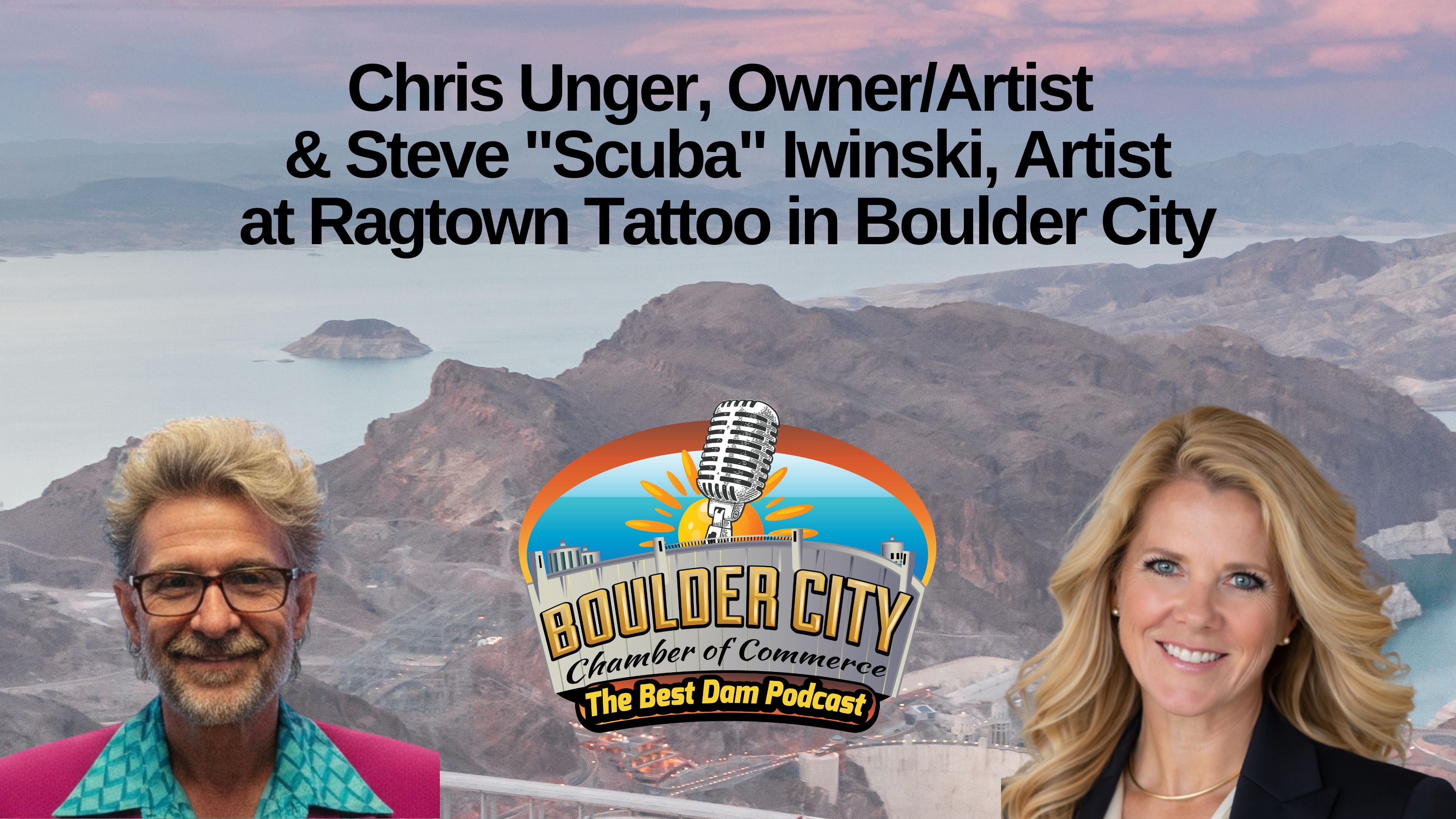
In this episode of The Best Dam Podcast, Jill catches up with Chris Unger, owner of Ragtown Tattoo, and tattoo artist Steve "Scuba" Iwinski. Jill, Chris, and Steve explore the history, craft, and shifting culture of body art in Southern Nevada. Chris shares how his journey from a small desert town led to founding Boulder City's first tattoo studio, while Steve reflects on growing up locally, building mechanical projects, and turning his passion for art into a lifelong career.

 Apple Podcasts
 Spotify
 Castro
 Amazon Music
 iHeartRadio
 RSS Feed
 In this episode of The Best Dam Podcast, Jill catches up with Chris Unger, owner of Ragtown Tattoo, and tattoo artist Steve "Scuba" Iwinski. Jill, Chris, and Steve explore the history, craft, and shifting culture of body art in Southern Nevada. Chris shares how his journey from a small desert town led to founding Boulder City's first tattoo studio, while Steve reflects on growing up locally, building mechanical projects, and turning his passion for art into a lifelong career.
This isn't just a story about running a studio; it's about navigating strict health regulations, embracing the technological evolution of tattooing, and acting as both artist and active-listener for clients marking meaningful moments in their lives.
DISCUSSION
- The Spirit of BC's Original: Chris reflects on Ragtown Tattoo earning the unique distinction of becoming the very first licensed tattoo shop in Boulder City history.
- Behind-the-Scenes Regulations: A look at the health district requirements, bloodborne pathogen certifications, and zoning ordinances needed to open and maintain a professional studio.
- From Taboo to Mainstream: How public perception of body art has shifted over the decades across all professions, demographics, and local communities.
- Tools of the Trade: Comparing old-school needle building and machine tuning with modern disposable cartridge systems and advanced pigments.
- Wild Shop Stories: Unforgettable moments from the chair, including a client's intense spiritual chanting and a brief stomach tattoo.
- More Than Just Ink: Exploring the deep emotional bond that forms between tattoo artists and their clients.
- Overcoming the Fear of Failure: Chris shares his philosophy on human creativity, overcoming self-doubt, and unleashing your inner artist.
- A Decade in Boulder City: Celebrating Ragtown Tattoo's 10-year anniversary and introducing the team behind the shop.
LEARN MORE
To learn more about Ragtown Tattoo and view their work, visit their studio in the historic district of Boulder City. To learn more about the Boulder City Chamber of Commerce, visit their website at https://www.bouldercitychamber.com.
KEYWORDS
Ragtown Tattoo, Chris Unger, Steve "Scuba" Iwinski, Boulder City, Tattoo Studio, Historic District, Nevada Small Business, The Best Dam Podcast
#RagtownTattoo #ChrisUnger #ScubaSteve #BoulderCity #TattooArt #NevadaSmallBusiness #TheBestDamPodcast
# Chris Unger - Ragtown Tattoo
[00:00:00]
[00:00:41] **Jill:** All right, we're tag-teaming it today with Ragtown Tattoo and Chris Unger. Thank you so much, owner of Ragtown. Thank you. And Scuba Steve Iwinski, thank you so much for being a part of the show today. You guys are pretty iconic here in this community, and such an amazing opportunity [00:01:00] to have a tattoo shop right here locally.
They don't have to travel. You guys are phenomenal, super talented- Yeah, thank you ... in your artistry- Thank you ... and skill. So thank you guys so much for being here.
[00:01:09] **Chris:** Of course. Thanks for having us. Thanks for the opportunity, yeah.
[00:01:11] **Jill:** So how many tattoo artists do you actually have in, at Ragtown?
[00:01:16] **Chris:** Four. Four?
Including myself, yeah.
[00:01:18] **Jill:** Very good. So it has, moving from the, Marshall Plaza, your old location, to the historic district, were you able to, did you gain space? Were you able to add more people?
[00:01:30] **Chris:** yes, but that wasn't the focal point. The original spot that I had was just me in a little private room.
[00:01:38] **Jill:** Ah.
[00:01:38] **Chris:** And I had really no intentions on hiring anybody. I didn't know, how it was gonna be received in Boulder.
[00:01:46] **Jill:** Yeah.
[00:01:47] **Chris:** So I wanted to keep it small for many reasons, economically, obviously, financially. but within the first year, with Boulder's big hug, I was like, "All right, this can go [00:02:00] somewhere." So then I started looking for more space.
and then at that time, I thought to myself like, maybe I'll just find another artist," 'cause I didn't... managing tattooers is not fun.
[00:02:12] **Jill:** Oh, okay. Sorry, Scuba Steve ...
[00:02:14] **Chris:** managing, no, I think- I'm part of the
[00:02:16] **Steve:** reason
[00:02:16] **Jill:** for that ... it took me many years to find a few that I don't have to manage, but it took me many years to get there, That's interesting. I woulda- Yeah ... because they're artists, and they kinda live in that artsy fartsy kind of world, right? And so controlling that and still running a business, 'cause it is a full-on legitimate business that you have done some amazing things. one of the things in researching a little bit before, the amount of,legalities that go into it, so the certifications and- Yeah
the different checks that you have to have. Yeah. K- share a little bit about what you have to do. Well- And who regulates it?
[00:02:50] **Chris:** it's regulated certainly by the health department, because we're dealing with, bloodborne pathogens and communicable diseases on an intimate level.
and then of [00:03:00] course, all the city and county ordinances, and variances, and you know, zoning, and all of those things. You gotta be in a proper area. and of course, you gotta pay to play, Like-
[00:03:09] **Jill:** ...
[00:03:09] **Chris:** and, It can be laborious going through all those hoops, especially in setting everything up because, you know,the licensing with the county may be, hinged on your licensing from the health district.
And then at the same time, you gotta show, proper leases and insurance, and all of these things, have to kinda... they're kinda fragmented, and then you gotta, get them somewhat in limbo, and then, get them all together, and then slap them together. Tie
[00:03:39] **Jill:** them all together.
[00:03:40] **Chris:** Yeah, and then it's "Okay, well, you're approved here and approved here," and it's...
So it's definitely a, can be a task, for sure.
[00:03:47] **Jill:** A lesson learned. and you guys have the, nobility of being the first- ... tattoo shop in Boulder City.
[00:03:54] **Chris:** That blew me away.
[00:03:55] **Jill:** Isn't that crazy?
[00:03:56] **Chris:** It is nuts. I totally... Like, when I heard that from the [00:04:00] lady at the city when she handed me my license-
[00:04:02] **Jill:** Yeah
[00:04:02] **Chris:** I was like, "What?"
[00:04:03] **Jill:** I think it's impressive.
[00:04:05] **Chris:** I can't say that, I intended on doing it, But it is certainly cool to put on your belt, Yeah. we were the first-
[00:04:11] **Jill:** Yeah ...
[00:04:11] **Chris:** for sure.
[00:04:11] **Jill:** That's quite the feather.
[00:04:12] **Chris:** And it's great to, I've kind of taken it into, my marketing as, BC's original-
[00:04:18] **Jill:** Yeah
I love that. So let's kinda go back to the history of the art of tattooing anyway. I think it's fascinating. So you know, we see it in different cultures. It represent in different symbolism. And so as it has evolved, and it seems, now it's so acceptable. Before, gentlemen that would have a professional job, they had to have long-sleeve shirts on so it did, it covered everything.
Nowadays, it is so acceptable. It is so just, almost expected that everybody has one. So are you seeing that, that kind of, that cultural change right here in Boulder City?
[00:04:53] **Chris:** Absolutely. You wanna take that one, Scoot?
[00:04:56] **Steve:** Yeah, I remember a time growing up out here where I was that weird tattooed [00:05:00] kid, you know?
There was certain, friends whose parents wouldn't allow me to come over to the house after a certain age just because
of it.
And now we have, police officers, firefighters, doctors. There's all kinds of people that are more open to being tattooed, and it's-
[00:05:13] **Jill:** ...
[00:05:13] **Steve:** it's cool to be a Making some headway, you know- Yeah
as far as society is concerned.
[00:05:18] **Jill:** I agree, and especially because it is so artistic. Your skillset, I've seen so much of your work, and your skillset is just incredible. Thank you. And how you visualize that and know how to put that, 'cause it's permanent. Yeah. It's not it's not like you're using chalk out on the sidewalk.
[00:05:36] **Steve:** You can't wipe it away if you make a mistake, Yeah, it's very- You gotta- ...
[00:05:38] **Chris:** expensive and painful to remove.
[00:05:41] **Jill:** Yeah, and I can imagine that you probably have connections with people when they want to do that. You probably know the perfect doctor or, tattoo removal location you can go to.
[00:05:49] **Chris:** there's so many of them now, and so many of them are generic. you don't need much training to be able to remove a tattoo, and I know this because I [00:06:00] contemplated at one point in time learning how to do it-
[00:06:02] **Jill:** Oh ...
[00:06:02] **Chris:** because I was fixing so many older tattoos that people weren't happy with.
And so there's no... I could easily buy a machine. They'll finance them, and, there's, an online course you can take, that's pretty- Oh,
[00:06:15] **Jill:** that sounds safe.
[00:06:16] **Chris:** And the next thing you're just burning people with light, Oh. taking their tattoos off. But to go back real quick, tattooing, to your, the original question, how old, and it, thousands of years.
Thousands. there's- documented cases of, Egyptian period where people- mummified people that had markings on their skin. Yeah. you can say it's as old as dirt. but as far as being taboo goes, it's no longer taboo. Yeah. Everyone's got them. and now I think it's more so a case of, the subject matter-
[00:06:47] **Jill:** yes
[00:06:47] **Chris:** as to what's gonna be taboo. You know, like,if somebody's,got something that's, not so pretty.
[00:06:54] **Jill:** Or appropriate.
[00:06:55] **Chris:** Or appropriate. Yeah. Yeah.
[00:06:56] **Jill:** yeah. And we do see a lot of that, but yet [00:07:00] nowadays it's even okay to be expressive. they're just expressing themselves. They're just being who they are.
And so-
[00:07:05] **Chris:** Almost too much.
[00:07:06] **Jill:** I know in some ways that can be a concern, but I guess that you're just providing a service. You don't get to help them make that moral decision, do you?
[00:07:15] **Chris:** Oh, absolutely. Because at the end of the day, we hold the machine, and I don't have to do what you don't want or what you want done.
we-
[00:07:23] **Steve:** Yeah, there's a lot of times where being a tattooer, you're kind of the voice of reason a lot of times. Yeah. Someone will bring you an idea, and you have to really make sure, like, "Hey, this is for life. Are you sure you wanna wear- ... that forever, or is this just a cool trend right now?" Yeah.
[00:07:36] **Jill:** Yeah. I can imagine there's plenty of cool trends going on too, right?
[00:07:40] **Chris:** I mean, well, there's... Yeah. it's... We try to explain to people, "Look, these are trends right now, and then when it's out of style, you can't take it to the thrift store and turn it in." it's there, And then you get to a certain stage where you've done it long enough to where you can, make modifications that allow it to be, [00:08:00] capture what the person wants, but at the same time, keep it timeless and- Unappropriate or whatever
[00:08:08] **Jill:** So over time, has the equipment, the ink, has it all evolved?
Is it getting better?
[00:08:14] **Steve:** Oh my God, so much. when I was in my apprenticeship, I had to learn how to build the needles. you had to clean out all of your tubes, 'cause they weren't single use. You had to learn how to tune multiple machines to do multiple different jobs. And nowadays you have little needle cartridges that you can just toss in a sharps bin afterwards, and-
[00:08:32] **Jill:** Wow
[00:08:33] **Steve:** my one machine I use on a daily basis, it does lining, shading, big lines, small ones. It does everything. So they're more of instruments nowadays, we like to say, than, you know- Yeah ... actual equipment-
[00:08:44] **Jill:** Yeah ...
[00:08:45] **Steve:** for tattooing.
[00:08:46] **Jill:** and so I would imagine that there's probably different levels too. So you have, a high-end...
It's gotta be expensive to keep all of that.
[00:08:54] **Steve:** considering normally what you're charging for a tattoo, a box comes with, say, 20 cartridges in it, it's [00:09:00] like, let's say I pay, 30, 40 bucks, nothing crazy.
[00:09:02] **Chris:** Yeah.
[00:09:03] **Steve:** So I mean, we definitely make enough to pay for the supplies, but compared to what it used to be when you were building your own needles, yeah.
Price has gone up significantly.
[00:09:11] **Chris:** Yeah, building your own needles was a- Time-consuming process, but it was value- it's valuable knowledge. and the new crop of tattooers don't even understand what that is. You know? As to where,I like to consider myself mid-school. I'm not old school, but I was kinda taught by some old-schoolers.
and he had the same kind of experience even though he's a little bit younger than I. But we were taught in those older ways.
[00:09:36] **Jill:** Yeah.
[00:09:37] **Chris:** And, a lot of newer tattooers just don't even understand the functionality of what's going on. They don't understand, the technology that goes into even making inks.
yeah, there's so much underneath, that goes into tattooing on a scientific level. not just in the machinery or in the pigments, but also in dealing with skin.
[00:09:58] **Jill:** Oh,
[00:09:58] **Chris:** Or dealing with [00:10:00] people's, the, there's so many different facets that go into it.
[00:10:04] **Jill:** And so is it harder if you're working or correcting somebody's previous one?
Is it harder to work on that or, like scar tissue build-up or something like that? Is that a legitimate thing that you have to worry about?
[00:10:16] **Chris:** Absolutely, yeah. And it's not always more difficult, but it more times than not can be, definitely more challenging.
[00:10:25] **Jill:** And how, what are, so I apologize, since- That's okay
I've never had, like a real, live tattoo. I've had my eyeliner tattooed on, We're gonna
[00:10:32] **Chris:** change that. That's
[00:10:33] **Steve:** real.
[00:10:33] **Jill:** it, yeah, it is. It still counts. it still hurt, yes. I will give you that one. I've
[00:10:37] **Chris:** never had a face tattoo, so I don't know. You're, that's a different level for you.
[00:10:41] **Jill:** It was, intense.
and I did come in and meet with the girl that you had at the old shop. Remember she was doing it-
[00:10:46] **Chris:** Oh yeah, Danny.
[00:10:47] **Jill:** Yeah.
[00:10:48] **Chris:** Yeah.
[00:10:48] **Jill:** I just watched her do one when Brian and I filmed it.
[00:10:52] **Chris:** Okay.
[00:10:52] **Jill:** One of our board members were like, "Okay, you're gonna be our guinea pig. We want you to lie down here. We're gonna film you getting your eyeliner tattooed."
And [00:11:00] she did great. She did fine through the entire thing, but afterwards I'm like, "Yeah, I don't think I can do it again." anyway, I will. I'll eventually do it, but so how do you, what are the, the measures that they have to take after they leave? So how do you keep it sterile? How do you let it heal?
what is that process?
[00:11:17] **Steve:** Oh, I mean, we have a whole aftercare sheet we like to have people take with them or take a picture of when they leave. and to every person out there, there's some people who prefer to use, you know, certain things on their tattoos that we'll recommend not to anymore that are more or- old school.
a while back, people would use lots of different petroleum products and things like that. Yeah,
[00:11:36] **Jill:** that's what I've heard. And- Vaseline ...
[00:11:38] **Steve:** and that was a big thing for a while, Aquaphor, things like that.
we recommend coconut oil to everybody- Oh ... just because it's more natural. It absorbs easier in the skin, along with all of the normal things you'll hear after getting a tattoo.
Don't get it sunburned, don't go swimming or-
[00:11:52] **Jill:** ...
[00:11:52] **Steve:** in anything with, dirty water or-
[00:11:54] **Chris:** Don't go mud wrestling.
[00:11:55] **Steve:** Exactly. Don't let your mom make it- Oh, yeah, that,
[00:11:57] **Jill:** that's one thing I have to worry about all the time. that's [00:12:00] really cool. Okay, so yes, I will, I'll be brave, and I'll come in.
[00:12:03] **Chris:** All right, you heard it. It
[00:12:04] **Jill:** needs to be tiny. You
[00:12:05] **Chris:** made it official. You made it official.
[00:12:07] **Jill:** I did. But it has to be tiny and, and it can't be in a spot that hurts the most. Like,everybody talks about on that ankle bone.
[00:12:13] **Chris:** It's not gonna hurt more than your eyes, I can tell you that.
[00:12:16] **Jill:** Okay, well, then maybe I can survive it.
[00:12:18] **Chris:** I'm sure you could.
[00:12:19] **Jill:** All right. I will be brave, and I'll come try it. Yeah. do you have any funny, personal experiences that have happened since you guys have been-
[00:12:28] **Chris:** Good Lord ...
[00:12:29] **Jill:** here in Boulder City? I'm sure there are plenty.
[00:12:33] **Steve:** You're gonna have to make me
[00:12:34] **Chris:** think with you. this is one of the questions I got stuck on, 'cause I was, like, sitting there, just in contemplation, "Man, which one do I choose?
There's so many, Like, from, crazy characters of people just wandering in, and ask, with crazy requests.
[00:12:49] **Jill:** Have you ever had anybody go, "Nope, they're halfway through it, can't do it, I'm out," and they only have half a tattoo?
[00:12:54] **Steve:** Nope.
[00:12:55] **Chris:** Yeah, so I had a kid once that, wanted some [00:13:00] lettering on his stomach.
[00:13:01] **Jill:** Ooh.
[00:13:01] **Chris:** And he was a young kid, and the stomach is notoriously painful. And, I got about one inch of a line into his stomach on the very first letter, and he quit immediately and was like, "I can't do this." And he was trying to be, like, a little tough kid. You could tell, his persona, what he was trying to represent- all those things. And, yeah, so that, that's definitely happened. He gave me 20 bucks and just left. That
[00:13:30] **Jill:** was like- And he's got a, he's got a line.
[00:13:32] **Chris:** Yeah, so I always wonder, and that happened really early in my career, Like, 23, 4 years ago. so I always w- I have always thought about that kid and wondered if he ever got it finished, but-
who knows? I've never seen him again.
[00:13:46] **Jill:** That is, that would be crazy.
[00:13:49] **Chris:** But Scoob had this one lady. Dude, the coyote lady.
[00:13:54] **Steve:** Coyote
[00:13:54] **Chris:** lady? The one that, so Scoob was tattooing this lady, and she's, like, [00:14:00] uber- spiritual person
[00:14:03] **Jill:** Okay ...
[00:14:04] **Chris:** but on, a different level of chaos, I don't know the right word, but s- Scoob's tattooing her, and she starts going into these crazy chants.
[00:14:11] **Steve:** Oh, man. Okay, yeah. I didn't know what you were saying until then. Yeah,
[00:14:14] **Chris:** now you do. You can take it.
[00:14:15] **Steve:** She just ended up started making the weirdest noises, and yeah, chants, I guess you would call them, to where, as an artist, you're listening to this, and you're like, it's clearly from pain, but there's nothing I can do for you at this point other than just let you do what you gotta do, So we just kinda side-eye each other, like, all right, let her do- I know, like- ... what makes it better ...
[00:14:33] **Chris:** but the shop is full. there's bystanders in there. There's people waiting, and she's going off. And I'm like, I never associated it was, like, from pain. I just thought she was in some sort of weird mindset of, trying to achieve enlightenment or something like that.
And I was like... And I'm looking at Scoob, and he's looking at me, and I'm just like... It was really awkward, It was, like, really awkward.
[00:14:56] **Jill:** That is funny.
[00:14:57] **Steve:** And I wasn't gonna-
[00:14:57] **Chris:** but at the end- ...
[00:14:57] **Steve:** disturb her either with that. And I wasn't gonna [00:15:00] disturb it either. this is happening. Yeah.
[00:15:00] **Chris:** yeah, none of us disturb- Like, we just kinda was like, "Man, is she having, a...
Is she possessed?" Out-of-body moment? Yeah. what's going on here? It was nutty, man. Or
[00:15:08] **Jill:** head started spinning, you would've been a little more concerned. Oh, yeah. so that kinda takes us to a little bit more of that culture of the almost addictive state. I've heard so many people say that it is almost addictive.
Once you have it, you just, you need more. And so is there a point where it's too much? Or is it a point where it's, almost mentally detrimental? Because if they just keep needing more and it's addictive, I'm not sure that's a great place to be.
[00:15:34] **Steve:** No, definitely not. And that's when you start to see the people that actually start to make mistakes- is because they're just so interested in being in the shop and collecting something new that they don't think about it too much. Lots of people just find something on the internet, and they're like, "Hey, this is cool. I want something like that," when they haven't thought about it at all. but yeah, addicting for sure.
I've had clients that have come in, every single Friday just to get one new little tiny thing added to them, and no matter how many times you add something [00:16:00] new, all they see is the empty space that's left. So as soon as they go home, they're like- Oh ... how do I fill that now?"
[00:16:06] **Jill:** Oh, they're trying to fill a void.
[00:16:07] **Steve:** Yep. Oh.
[00:16:07] **Chris:** There's no doubt. And I've had clients come in with bigger projects, with regular sessions, and literally come in, get in the chair, I'll go- I'll start working on them, and three hours later, they have indulged so much information personally, and even to the point of tears, and then, it's done, and they pay me, and they walk out and never even look at what I did.
[00:16:33] **Jill:** It's almost like you're more of a therapist.
[00:16:36] **Chris:** 100%- In a way it is ... therapy. Absolutely. Wow. And it... But it's more so on many levels 'cause it's also the physical therapy. I think- We, let's face it, In the modern age, everything's excessive.
it's a challenge to be simple and minimalist-
[00:16:53] **Jill:** because we're just inundated with everything-
...
[00:16:55] **Chris:** all the time, whether it be information or consumer goods or whatever it is. [00:17:00] Goals, you know- ... like, all of these things. And there's, like, this, I don't know, subliminal drive to just want more all the time- ... but people don't even realize why, and is it needed?
Is it truly needed? And so when you see people that are just completely covered, and I've been in this business for 25 years and watched people take it way too far- Yeah ... and just go "What?" There's something... we're all tattooed pretty heavily, but some people, there's no boundaries.
They just keep going, and that, to me, screams like, "Hey, look at me."
[00:17:39] **Jill:** "
[00:17:39] **Chris:** Look at me," you know?there's something deeper going on, for sure.
[00:17:42] **Jill:** Yeah. Interesting, because I would imagine for most people that just get the single or, two or three tattoos, there's deeper meaning to it, but I feel like that person that gets addictive state, they're just literally filling a hole.
[00:17:55] **Steve:** Yep.
[00:17:56] **Chris:** Totally. Yeah.
[00:17:56] **Jill:** Yeah,
[00:17:57] **Chris:** absolutely, whether it be, some [00:18:00] sort of deep family issues or traumatic issues- ... or some people have a hard... I've noticed this too. Some people, The sadistic quality of liking pain
[00:18:10] **Jill:** Yeah, I would imagine. I mean, you and I have talked about my nephew before, an ink master, and I'm like, "Oh, I'm telling you, somebody's enjoying hanging from a ring in his back."
[00:18:19] **Steve:** Hooks, yeah.
[00:18:20] **Chris:** Yeah.
[00:18:21] **Jill:** I know it's-
[00:18:21] **Chris:** I don't know it's intense ...
[00:18:22] **Jill:** a little tough. That one's a tough one to even watch. I am, I'm just so impressed because the skillsets that you guys have are just incredible. Have you ever practiced your art off body and on paper or canvas or anything like that?
[00:18:38] **Steve:** Yeah, everything. I mean, most of us in the shop have some other form of, artistic outlet, whether it's painting, drawing, working with wood, metal, all- Yeah ... sorts of different things.
[00:18:50] **Jill:** That's very cool.
[00:18:51] **Chris:** My whole life has been creating, fabricating something, absolutely. but yeah, I think you find that [00:19:00] most artists, have a deep desire to just, I don't know, make something happen,
and I know in my case, it was always, I didn't grow up poor, but I didn't grow up privileged either.
And you had to be resourceful, and- You just kinda learn how to do things on your own, and the desire to wanna,you get inspired by seeing something and you're like, "Oh, that'd be fun," And you just go for it.
[00:19:30] **Jill:** I love that.
[00:19:31] **Chris:** and then don't... The, I think the worst thing that anyone can do, and I think like, I don't consider myself more of an artist than any other human on the planet, because I understand that art is simply a tool. I've just chosen to utilize it in a way that allows me to earn my living.
But a lot of people will identify as that thing, like that's who they are.
but that's not necessarily my style, and [00:20:00] I've heard, I've, There's a great amount of fear of failure in everything, and the majority of people are afraid to let themselves be creative because the fear dominates them.
Fear of what someone's gonna think, fear of failure, fear of... Fear is, the ultimate enslaver of all things- True ... in my opinion.
[00:20:19] **Jill:** I agree.
[00:20:20] **Chris:** So, like, the majority of people, they say to themselves, "I don't have an artistic bone in my body." Well, nonsense. that's complete nonsense. and I always use the analogy, like, at one point in time, you didn't know how to write the alphabet.
[00:20:33] **Jill:** That's true.
[00:20:33] **Chris:** And now you do. And if you did it every day, you could get really pretty with it, and ornate with it. And, so it's just let go of the fear and go for it.
[00:20:42] **Jill:** Well, my stick figure people will eventually turn into something beautiful, but- They
[00:20:47] **Chris:** will ...
[00:20:47] **Jill:** it's gonna take me a long time at this point.
[00:20:48] **Chris:** Which I have several stick figures tattooed on me, by
[00:20:51] **Jill:** the way. Oh, that is awesome. Yeah. That's... Maybe that's what I'll get.
[00:20:54] **Chris:** My daughter, I made her do this one on, Father's Day a couple years ago.
[00:20:58] **Jill:** So your kids are into the [00:21:00] same thing?
[00:21:00] **Chris:** No. I mean- No ... they receive them, but they don't have any desire to do them.
[00:21:05] **Jill:** That's interesting.
[00:21:07] **Chris:** Yeah.
[00:21:07] **Jill:** And so are they artistic, though?
[00:21:10] **Chris:** Oh, yeah. I have one son that's a all-in musician, producer. Wow. That's... He lives that life. That's all he does.
[00:21:17] **Jill:** That's cool.
[00:21:18] **Chris:** my other son, he's very creative, but definitely more on a hands-on,he's really into ar- artisanal woodworking and things like that.
[00:21:26] **Jill:** Oh, that's cool.
[00:21:28] **Chris:** And my daughter's a teen right now,She used to be creative, but she's in that space where it's no longer relevant. Scoob, though, like his son, go for it. he's always making cool stuff.
[00:21:38] **Steve:** Yeah, he, I mean, it's, a tough one nowadays to get him to actually wanna do anything artistic with me.
[00:21:43] **Jill:** How old is he?
[00:21:44] **Steve:** he's nine.
[00:21:44] **Jill:** Oh my gosh.
[00:21:45] **Steve:** And growing up around, the tattoo shop, and me painting all the time, and always being creative somehow, he doesn't realize how good he is at it.
So he's almost a little jaded to it in a way, too. Oh,
[00:21:57] **Jill:** interesting.
[00:21:58] **Steve:** He's so sick of, be like, "I don't wanna paint, Dad.
[00:22:00] Let's go on a bike ride." Like- ... "Man, all right, I guess we can, but as long as we do something else later that works your mind, too."
[00:22:05] **Jill:** Oh, there you go.
[00:22:06] **Steve:** But he's, yeah, very creative. He, some of the paintings he's done, I had a few hanging up in the shop for a while, and- Oh, neat ... people would come in and compliment the rough style of it, and I'm like, "That's actually not mine.
That's my son's, but I'll tell him you said so."
[00:22:18] **Jill:** that's pretty cool, though. Yeah. I think that's awesome. I'm so glad you guys share your talents, though. That's, you know, it's like you said, I think everybody does have some skill set, some talent, some artistic ability. They just aren't, haven't developed it yet, or-
[00:22:31] **Chris:** Yeah, totally
[00:22:32] **Jill:** it's not in their time, right? So everybody has a season- Yep ... everybody has a time, and maybe they just haven't gotten there yet. So let's learn a little bit more about each of you guys. All right. So Chris, what was your first job?
[00:22:43] **Chris:** first, well, if we're going way back, it's definitely a paper boy, but, mowing lawns and stuff like that.
But, real official job, I was a janitor at,a, an old folks retirement community.
[00:22:55] **Jill:** Did you have a big ring of keys?
[00:22:57] **Chris:** No, I had a couple keys- Oh ... but,
[00:22:59] **Jill:** Then you weren't a [00:23:00] true janitor if you didn't have- I know. ... a ring
[00:23:01] **Chris:** of keys. I wasn't. I think I was, like, 15 years old.
[00:23:04] **Jill:** Oh, there you go. Yeah.
[00:23:06] **Chris:** Yeah, that was my-
[00:23:06] **Jill:** That's
[00:23:06] **Chris:** awesome
I just, you know, cleaned up after old folks on a regular basis.
[00:23:10] **Jill:** that probably taught you a lot of compassion, a lot of patience.
[00:23:13] **Chris:** Definitely a lot of patience, and yeah, it definitely show you some things about- behavior-
[00:23:21] **Jill:** Yeah ...
[00:23:21] **Chris:** that you didn't know existed.
[00:23:22] **Jill:** Growing old is not easy. No. That is for sure.
All right. Scuba Steve, what was your first job?
[00:23:28] **Steve:** Tony's Pizza here in Boulder.
[00:23:30] **Jill:** Oh, imagine that. I think every- Is this mine? Every child... Yes, it is. how many people do you know? I think every child did. Yeah. That is awesome. If in my generation, that, Tony's was your generation. My generation was, back in the time there was a, where the Southwest Diner moved from.
Remember the- Okay. Yep ... it used to be the drive-through? What was that called? It was called Frosty Freeze. Yeah, exactly. And yeah, Frosty Freeze is where all the kids worked.
[00:23:52] **Chris:** So you grew up here, too?
[00:23:53] **Jill:** Yep, born and raised.
[00:23:54] **Steve:** Wow.
[00:23:55] **Jill:** Yeah.
[00:23:55] **Chris:** That's
[00:23:55] **Jill:** awesome. Yeah. Family's been here since '47.
[00:23:58] **Chris:** That's incredible.
[00:23:58] **Jill:** So yeah, multiple [00:24:00] generations. And, Lex and Scuba, did you graduate with Lex, right?
[00:24:04] **Steve:** I was 2009. I believe she was a year behind me.
[00:24:07] **Jill:** Got it. very good. And what is something that people may not know about you, Scuba Steve?
[00:24:13] **Steve:** Oh, that is a very good question. I mean-
[00:24:16] **Chris:** It's
[00:24:16] **Steve:** a lot ... there's countless things people don't know.
Yeah, there's a lot I keep down deep. mainly not just, my love for art and everything like that, but also anything automotive, anything that has, an engine and makes- ... explosions, that can run. I'm a car guy through and through. I got into motorcycles at a certain point, and building anything mechanical, I would say, is probably my second thing next to tattooing that I'm just completely obsessed with.
[00:24:40] **Jill:** That's awesome. I do remember you had a motorcycle that you rode back and forth to, Flight Lines- Yeah ... when you worked for Bryna.
[00:24:47] **Steve:** Yep, still got it. It's in storage next to all my other cars.
[00:24:50] **Jill:** that is awesome. And is that where you got the na- the nickname Scuba?
[00:24:54] **Steve:** No. my great-grandfather started calling me it when I was a young kid.[00:25:00]
Over the years, I had very few friends that did, and then right around the time I started at Tony's was when it just really took off for some reason. Someone there said, "Hey, have you ever been called this?" And I told them, "Yeah, kinda my whole life." And then every single person there called me that.
[00:25:15] **Jill:** That's funny.
[00:25:15] **Steve:** And then eventually all my friends ...
[00:25:16] **Jill:** I just figured you got it at Zip Lines because it seemed like everybody there had a nickname.
[00:25:20] **Steve:** Oh, no, it was well-established by that point. That's funny. I think that's how I introduced myself when I did the interview.
[00:25:26] **Jill:** That's awesome. That'll get you a job for sure.
[00:25:29] **Steve:** Yeah, it worked. I didn't have to wait for all of them to come up with something stupid like some of the other people I hired. Oh, yeah, there you go. There you
[00:25:34] **Jill:** go. You preset your own name. Yep. That is awesome. I love that. Good
[00:25:37] **Chris:** tactic.
[00:25:38] **Jill:** And so Chris, what's something people don't know about you?
[00:25:43] **Chris:** I grew up in a town that's makes Boulder look like a metropolis.
literally 800 people.
[00:25:52] **Jill:** Wow. where was this?
[00:25:53] **Chris:** In Southern California on the Salton Sea.
[00:25:56] **Jill:** Oh.
[00:25:56] **Chris:** Out in the desert.
[00:25:57] **Jill:** Yes. In
[00:25:58] **Chris:** a really small town called Bombay [00:26:00] Beach. my grandparents vacationed out there, in the '70s, and we all lived in the LA area at the time. and we were going out there every week, and they ended up retiring and buying a little bar and grill out there.
there was only one. actually there was two, but, they bought the one. and my parents were going out there every weekend, and me and my sister going along with. My parents would help them in the bar. My dad would help the, my grandpa in the bar. My mom would help my grandmother in the kitchen.
[00:26:32] **Jill:** Oh, cool.
[00:26:33] **Chris:** And I would just run amuck. I had friends out there. We had dirt bikes and I would just run amuck in the desert. And then shortly after that, parents got divorced, Mom went out there, and we went, my sister and I went with. So mostly just grew up out there in the, you know-
[00:26:47] **Jill:** That's awesome ...
[00:26:48] **Chris:** middle of nowhere.
Yeah, it was a... I mean, people see it now and they hear about it, and they're just like, "Wow, you grew up in that place?" 'Cause it's It's in a state of destitute now, but it, back then in the '70s and '80s, it was just this wonderful [00:27:00] place to, to grow up of just pure freedom.
[00:27:03] **Jill:** You know, that's interesting that you see it through that lens, right?
Because I am the one that saw it through the lens of us taking side-by-sides out there, taking our kids, and going to the sea area, Salton Sea area. Yeah. And then, and there's baby dolls crusted over with dust- Yeah ... just laying there next to a swing set, and it just looks so eerie- Yeah ... and creepy that I was like, "Ugh, I just wanna get out of here.
I got a negative vibe here."
[00:27:28] **Chris:** Yeah.
[00:27:28] **Jill:** And so I saw it differently. I think it's interesting that you saw it when it was thriving.
[00:27:33] **Chris:** Yeah, it was thriving. Like, in, back in the '60s,mid-'60s into the early '70s, there was a concerted effort to create this, French Riviera-
[00:27:42] **Jill:** ... on
[00:27:42] **Chris:** the Salton Sea.
And all of the folks from Hollywood and LA would vacation out there.
[00:27:47] **Jill:** Wow.
[00:27:48] **Chris:** Palm Springs and the entire area. Yeah. And that's the way it was going into, the '80s. there was these little resort towns, kinda like on the river where you have resort towns.
and that's what folks would do.
They would [00:28:00] come out there and just vacation and recreate and have a good old time. And then, The sea just became very, the salt saturations in the sea became so extreme that all of the wi- all the fish were dying-
[00:28:14] **Jill:** Yeah ...
[00:28:15] **Chris:** and they were washing up onto the shores, and that obviously changed people's desire to wanna camp out- and hang out on the shores or even buy places out there. that in turn affected, my grandparents' business as well and, 'cause we relied so much on vacationers.
[00:28:30] **Jill:** So Mother Nature took its course.
[00:28:32] **Chris:** Yeah, and then so the migratory birds stopped going there, and next thing you know it just, slowly died out
[00:28:37] **Jill:** and,
[00:28:37] **Chris:** you know- Interesting ... that's the way it went, and it's not really recovered.
[00:28:40] **Jill:** Yeah. it's been a long time since I was there, but- Yeah ... it did not seem in a recovery mode when I was there.
[00:28:46] **Chris:** No. When's the last time you were there?
[00:28:47] **Jill:** It's been about 12 years ago.
[00:28:49] **Chris:** Yeah. It's the same-
[00:28:51] **Jill:** Wow ...
[00:28:51] **Chris:** if not worse. Well- and there's actually ways that they could improve it and clean it, but from what I hear and what I've read, California doesn't wanna put- [00:29:00]
[00:29:00] **Jill:** The effort into it
[00:29:01] **Chris:** the resources into it. Yeah.
[00:29:03] **Jill:** So this is one of my favorite questions 'cause you really get to know people. what book are you reading right now, Chris?
[00:29:10] **Chris:** Several, but, my favorite... I'm reading one right now called The Secret Teachings of All Ages.
[00:29:16] **Jill:** Oh, interesting.
[00:29:17] **Chris:** Yeah. By, Manly P. Hall.
[00:29:20] **Jill:** Sounds kinda deep.
[00:29:21] **Chris:** It can be, yeah.
[00:29:23] **Jill:** That's interesting.
[00:29:23] **Chris:** it's very, enlightening and scary at the same time.
[00:29:26] **Jill:** Ooh.
[00:29:27] **Chris:** Yeah.
[00:29:27] **Jill:** Sometimes those are good, and then sometimes you're like, "Oh, I wish I hadn't read that."
[00:29:31] **Chris:** Yeah, totally.
[00:29:33] **Jill:** All right. Scuba Steve, what are you reading?
[00:29:35] **Steve:** Ugh, besides the, owner's manual to my car? I don't do a whole lot of reading as far as- fantasy stories.
And most things I read are, like, educational, how-tos and whatnot.
[00:29:44] **Jill:** Yeah.
[00:29:45] **Steve:** lots of Goosebumps with my boy.
[00:29:47] **Jill:** Oh, that's sweet.
[00:29:48] **Steve:** if I ever do read any, novel-type things, usually it's like a Stephen King-
[00:29:52] **Jill:** ...
[00:29:52] **Steve:** Dean Koontz type of book. Something with a little bit of, you know-
[00:29:54] **Jill:** Yeah ...
fright to it to keep you on your seat, You're into that. Interesting. I think that, [00:30:00] speaks volumes. That's great. I appreciate you guys sharing that kind of stuff. All right, so here's the next question. What's something your mom or dad taught you that you still have as a life lesson you live today?
[00:30:15] **Steve:** Just always be the best person you can be and at whatever you're doing, No matter what you're doing, try as hard as you can, and even if you fail, hey, you learned something.
[00:30:24] **Jill:** That's right. I think some of the best lessons are learned from failure.
[00:30:28] **Steve:** Yeah, totally. Oh, 100%.
[00:30:30] **Jill:** Yeah. That's pretty cool. Thank you. I'm glad your mom and dad taught you so well.
[00:30:34] **Steve:** Oh, they
[00:30:35] **Jill:** tried. How about... Yeah, they tried.
They did a pretty good job. Yeah. And Chris, what about your mom and dad?
[00:30:42] **Chris:** Well, immediately, it's, my mom said, "The more you make, the more you spend." And then my dad said, "The more you do, the more they expect."
[00:30:51] **Jill:** And that's always kind of stuck with me. and it's a constant challenge in many ways, I truly am challenged with [00:31:00] both of those statements.
[00:31:01] **Chris:** Yep.
[00:31:01] **Jill:** Yeah, it does, it seems like the more you make, you just have more things you want.
[00:31:05] **Chris:** Yeah.
[00:31:06] **Jill:** So then you gotta make more, so then you want more. And so back to a statement that you said earlier in the interview, the challenge is to be a minimalist and to live with just being okay with who and what you are and not needing the excess.
[00:31:19] **Chris:** Yeah, exactly.
[00:31:19] **Jill:** And that is a lesson I struggle with. Just ask my husband.
[00:31:23] **Chris:** it's a constant effort in my life, you know- Yeah ... because it's like now I'm in a space where it's more easy, it's easier to obtain many things that I just simply don't need.
And but, I want them, but I don't need them, so, like, I have made progress with it.
[00:31:39] **Jill:** That is great. And then the other statement that from your dad, the more you do, the more people expect, we'd also don't wanna live with mediocracy. So you don't want to just not do anything so there is no expectation level, but you also have to learn to manage that expectation, manage your, need for overachievement, right?
So that one's like a mixed [00:32:00] bag.
[00:32:00] **Chris:** Well, for me, that one's- So it's, okay, I view everything as energy, and it's okay, do I wanna put this energy into that? Does it serve the entirety the way it should?
Or is it not that? You know what I mean? So, like, it also teaches me to be, selective about where I want to put my energy, and is it for the greater good?
Is it righteous, or is it because this person's just trying to manipulate me,
[00:32:30] **Jill:** Yeah. I love it. Great mindset. Thanks. Thanks for your words of wisdom. I appreciate it. I appreciate you guys both being here. Like I said, your talents are incredible.
thank you. Thank you for sharing those with us, sharing your information today, and, this is gonna be a great episode. Can't wait for it to air and, for the first person to say, "Okay, what tattoo are you getting?" 'Cause I'm sure somebody will actually ask that, probably my husband-
[00:32:51] **Chris:** Yeah ...
[00:32:52] **Jill:** or my kids. But you guys are awesome, and I would only do it with you, so thank you very much.
[00:32:57] **Chris:** thank you as well.
We appreciate you. I do wanna just quickly add, [00:33:00] too, that- Yeah ... Ragtown just passed 10 years.
[00:33:02] **Jill:** Oh, that's right. Yeah.
[00:33:04] **Chris:** 10 years.
[00:33:04] **Jill:** That is right. It's pretty insane. I forgot about that. And so before Ragtown, you were w- at Pokers?
[00:33:09] **Chris:** Yeah, I owned- Yeah ... a shop in Vegas called Pokers.
[00:33:11] **Jill:** Yeah, that's right. I remember you telling me that a long time ago.
congratulations.
[00:33:16] **Steve:** Thanks.
[00:33:16] **Jill:** You, have some lasting power now.
[00:33:18] **Chris:** Yeah. I mean, made it a decade. That's an achievement.
[00:33:21] **Jill:** you did great. Well, a lot of achievements. and
[00:33:23] **Chris:** I didn't do it alone,
[00:33:24] **Jill:** And so thanks to all of your artists that are there, and, what are the names of your other two?
[00:33:28] **Chris:** Scoob.
And then there's Cornfed, who's a legend in the game. He's been around for many years, and actually was pretty, He was implemental in getting things legalized in Clark County back in the early '90s.
[00:33:42] **Jill:** Wow.
[00:33:43] **Chris:** Early '90s, yeah. when, they didn't really know what to do with tattooers, as far as regulation goes.
[00:33:47] **Steve:** Wow.
[00:33:48] **Chris:** Which is a good thing, but at the same time, I give them fault, too, because now they, you know, they watch a little too closely sometimes.
[00:33:54] **Jill:** Oh, too bad.
[00:33:56] **Chris:** and then there's Jackie, Jacqueline Grab, who's,our resident, lady [00:34:00] tattooer with impeccable technique and, yeah.
[00:34:02] **Jill:** So- And does she do permanent makeup?
[00:34:04] **Chris:** No.
[00:34:05] **Jill:** No.
[00:34:05] **Chris:** No. we all have the ability to do permanent makeup. It's just not something that we- You know, on their advertise Specializing
[00:34:13] **Steve:** Exactly. I tell people all the time, "You don't want me doing your eyebrows. I have no idea what's going on with a good-looking eyebrows." Go to somebody else with that.
[00:34:22] **Chris:** Yeah, you look, you walk away looking, inquisitive all the time.
[00:34:25] **Steve:** Unless you want to look like Bert and Ernie.
[00:34:27] **Jill:** go
[00:34:27] **Steve:** somewhere
[00:34:28] **Jill:** else. Or
[00:34:28] **Chris:** Eugene Levy. Unibrow. Yeah.
[00:34:31] **Jill:** I'll skip that, thanks. Not a selling tactic there. you guys are awesome. Thank you so much. Thanks, Jill. It's been a pleasure, and, can't wait to come in and see you.
All
[00:34:39] **Steve:** righty. Right on. Thanks for having us.
[00:35:00]